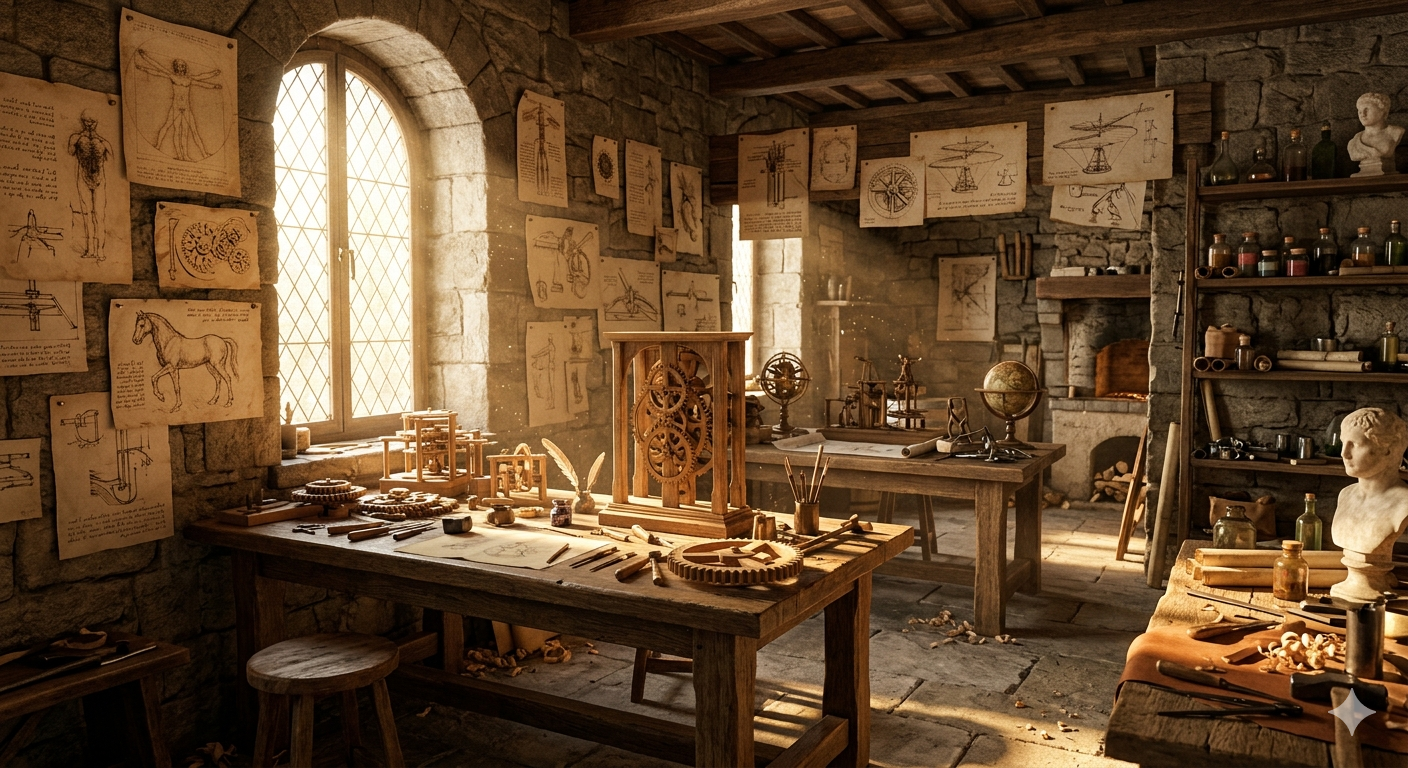
The Workshop
A reimagined view of a 15th-century polymath's workspace. Where art meets engineering.
License: CC BY-NC 4.0
Colophon
The Book of Jack was initially conceived as a coffee table book.
For context, it was September 1994 and the Internet was in its infancy. Websites consisted of static HTML tables and numbered less than 10,000 worldwide. There were no search engines. Most home computers only had 4 MB of RAM with average download speeds of about 35 Kilobits per second.
Browsing the web was very very slow and there was sometimes a great deal of anticipation as images filled the screen one line at a time, and hoping your computer wouldn't crash or lose the dial-up connection.
Today, this digital anthology …
Detailed Prompt for Tavernier’s Miélot Study (c. 1460)
This prompt creates a photorealistic, cinematic reconstruction of the medieval scriptorium, precisely mapping all specific objects and text from the original illumination (image_6.png) to a complex, three-dimensional environment.
Prompt Text:
A photorealistic, highly detailed cinematic reconstruction of the medieval scribe Jean Miélot in his meticulously recreated study in Bruges, c. 1460, based on image_6.png. The scene is rendered in a monochromatic grisaille-derived palette of sepia, grey-browns, bone whites, and aged vellum textures to maintain the original illumination feel. Miélot, a meticulous portrait in profile, wearing his authentic multi-layered grey robe and hood with a simple cap, is seated on a detailed wooden stool. He is in the identical profile pose, writing intensely in a large vellum manuscript placed on the complex, ornate, multi-part oak and walnut desk. The desk, with its unique triangular pyramid-like front structure holding the main manuscript and scroll with legible script, features intricate gothic carved motifs. Below the writing surface, four precise inkwells are visible on their small side-shelf. The surrounding large wooden shelving unit is packed with hundreds of highly detailed vellum and leather-bound books with metal clasps, arranged precisely as in image_6.png, including the open books propped up and lying on shelves. Specific details, like the open box on the far right top shelf containing the metal instruments and scrolls, are recreated with photorealistic textures. Above the shelving unit, the framed plaque with the verbatim text ‘au fil Du roy Dce wps’ is rendered as an aged carved wooden object with legible, old French script. The entire scriptorium environment is rich in wood grain and vellum pores, with cinematic soft, warm side-lighting from a nearby window highlighting dust motes and textures. Ultra-detailed, 8k resolution.
The Technology Stack & Architecture
The Writing Layer
-
The Book of Jack* is written in Scrivener, a comprehensive writing software designed for long-term projects that combines editing, file management, outlining and research tools into one interface.
-
Formatting the scrivener text is done with Markdown, a lghtweight, easy-to-read and easy-to-write plain text markup language used to format text for the web.
The Framework
- The Book of Jack is built with Jekyll, an open-source static site generator that provides the structure and organization needed to build websites.
The Data & Logic Layer
-
Using YAML (Yet Another Markup Language) for the data layer, keeps structured data such as references, images and navigation separated from the narrative content.
-
The logic for the site comes from Liquid an open-source, Ruby-based templating language that combines the various sources of content allowing for consistent design across multiple pages.
The Presentation Layer
- Bootstrap 5 is an open-source, mobile-first frontend framework for building responsive websites.
- HTML5 & CSS3 are the foundational technologies used to build web pages. HTML (HyperText Markup Language) provides the structure and content of a webpage and CSS (Cascading Style Sheets) controls the presentation and visual style of the site.
Infrastructure & Tooling
- iTerm2 Used for local development, providing a command-line interface to the Jekyll engine.
- GitHub is a web-based platform that provides cloud storage for Git repositories, version control, issue tracking, project management tools, and more.
- VS Code is a free, lightweight source code editor, the primary environment for website development.
- GitHub Pages Provides secure, version-controlled hosting and automated deployment.