Chapter 1 | Scene 1
Ascending the Theban Hills
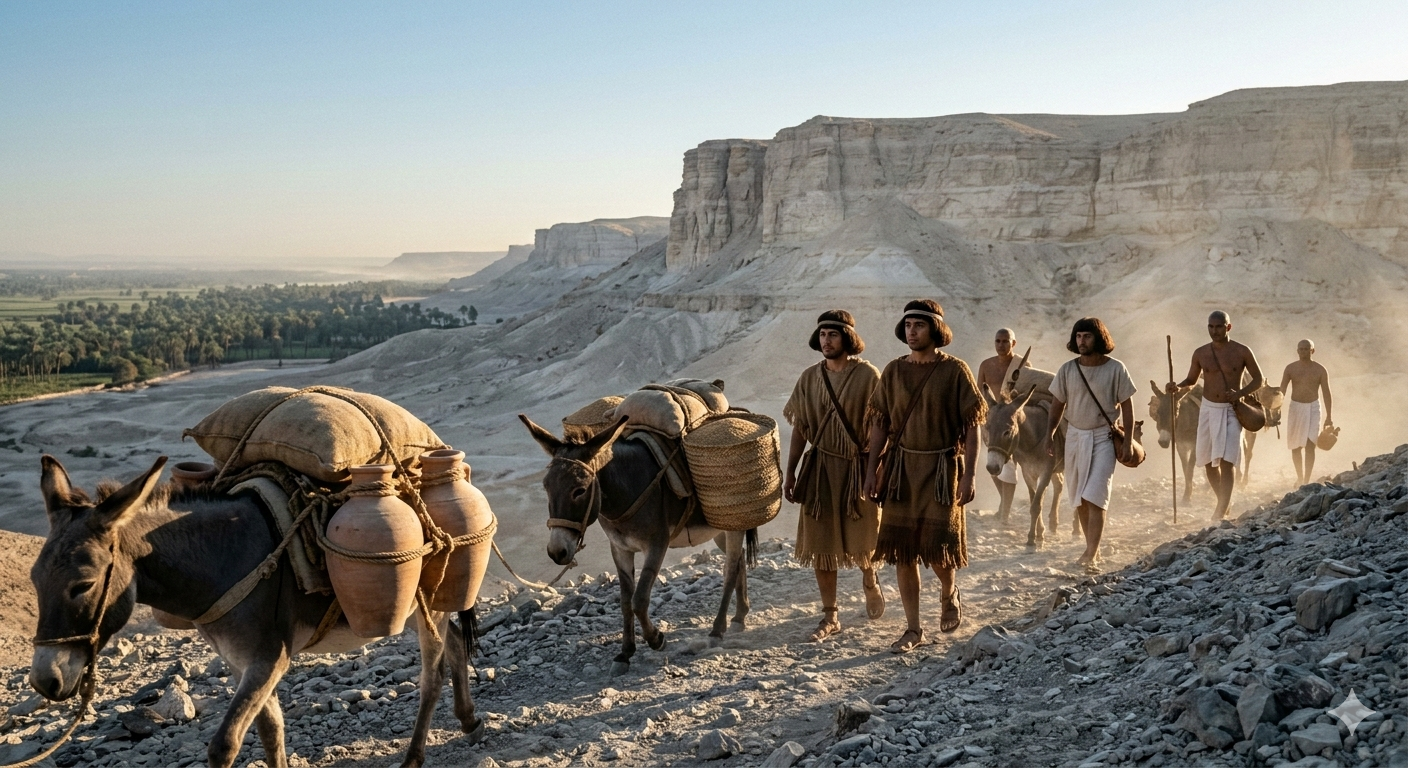
The transition from the Nile’s floodplains to the high plateau is a sensory threshold, a shift from the damp, organic scent of the lush river valley, to the dry, acrid-metallic dust of the Deshret.
The dawn light catches the Theban Massif at an oblique angle, turning the pale limestone into a searing orange-ochre. Unlike the valley below, where life is thick and noisy, the plateau offers a silence so profound it feels heavy.
The scribe Ameny, whose name is the diminutive of Amenemhat, the patron god of Thebes, lives in a mud-brick villa with a central courtyard, provided by the state. He and his family are well-sheltered and well-educated, they are literate and well-fed receiving rations of bread and beer, and portions of meat, figs, and honey.
While traveling with caravans across the Theban Plateau and beyond, he would have his own donkeys to carry his writing kit (palette, pigments, papyrus rolls), personal water skins, extra clothing, his own wooden stool, eating and tenting equipment. He also has a junior internist to handle the heavy lifting and tent-pitching and other assigned chores.
Ameny wore a kilt of fine white linen. While traveling, he had a longer cloak for the cold desert nights or a heavier sash. His head was cropped short and covered by a simple linen head-cloth to ward off the sun. The scribal palette was his badge of office, a long, rectangular piece of wood with two circular wells for black (carbon) and red (ochre) ink.
The scribe is an overseerer, a high-status government official, working for the Treasury to manage resources of the Pharaoh. He is the caravan program director and supply chain officer of the caravan traveling from Thebes to the Royal Court in Memphis.
Officially, Ameny is career tracking as next-in-line for the role * Overseer of the Seal: The chief financial official holding the title imi-r ḫtmt “Overseer of the Seal” or “Treasurer”. This was one of the most powerful positions in the royal court, responsible for the many products coming into the palace and the overall economic administration of all royal assets.
On this trip, he is travelling with state-funded military protection to ensure the security of precious commodities succh as the gold and semi-precious stones that were sourced from the Eastern Desert and Nubia and are used by the Pharaoh and his administration for royal regalia, diplomatic gifts, and to fund state-sponsored construction projects.
Exotic materials from sub-Saharan Africa via the Kingdom of Kush including ivory, ebony and ostrich feathers, high-quality linen cloth produced in Upper Egyptian workshops were used by the elite bureaucrats and other high-ranking officials, and originating from the Land of Punt, highly prized myrrh and frankincense were often used by temple priesthoods for daily rituals.
The cargo is significant.